


In Succession, Logan Roy takes a good, long look at his children and delivers the most devastating insult in the history of television:
You’re not serious people.
The devastation of this string of words is exceeded only by its mystery. What does it mean to be a “serious” person? What is “seriousness,” anyway?
We seriously need a theory of seriousness.
A serious theory of seriousness
Before we can understand our explanatory quarry, we must first understand its opposite: humorousness. Silliness. Frivolity. The stuff we laugh at and make fun of. What is going on with the unserious? Thankfully, I have a serious answer to that question that I can now share with you.
A serious theory of humorousness
Here’s how I summarize my theory in my academic preprint:
Human social life is filled with coordination problems: passing each other in a hallway, taking turns talking and listening, differentiating the meanings of "hook up with" and "meet up with," gathering at the same time and place, etc. But what happens when we suffer a mix-up—for instance, we get stuck dancing back and forth in the hallway, or I casually mention that I “hooked up” with your mother last night? Here, I argue that such mix-ups posed a significant adaptive problem for our ancestors, disrupting cooperation, damaging reputations, fomenting needless conflict, and destroying valuable relationships. Natural selection favored three solutions to this adaptive problem: 1) a sense of humor (i.e., the ability to detect, anticipate, and avoid mix-ups), 2) mutual laughter in response to humor (which creates common knowledge of the mix-up and defuses its costs), and 3) joking as a hard-to-fake signal of one’s ability to detect and avoid mix-ups (and thus one’s value as a coordination partner).
We can think of our social interactions as little games. Most of these games are coordination games, where we mutually benefit from aligning our behaviors, roles, and intentions. For example, passing each other in a hallway can be represented with the following payoff matrix:
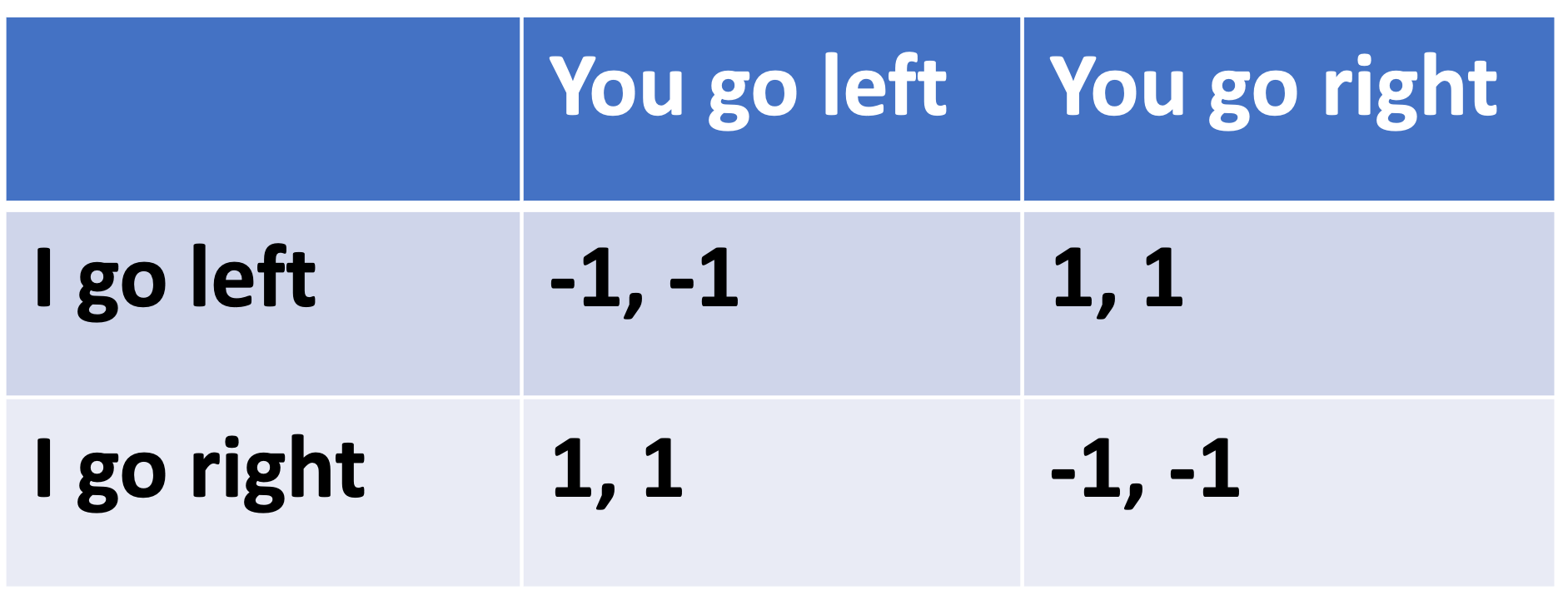
Now what happens if we continually bump into each other, or teeter back and forth for all eternity? Well, we laugh. The more times we shimmy back and forth, the harder we laugh. This is a major clue to the evolutionary function of laughter.
Of course, most of the coordination games we play are linguistic. We can think of language as a massive coordination game—a game we are playing right now—where we have all agreed on which symbols correspond to which things in the world. If we fail to coordinate, mixing up our words or intentions, we fail to communicate—a kind of verbal collision or linguistic misalignment. Here’s an example of one of our language games, where the shared goal is to use “LOL” to mean the same thing:
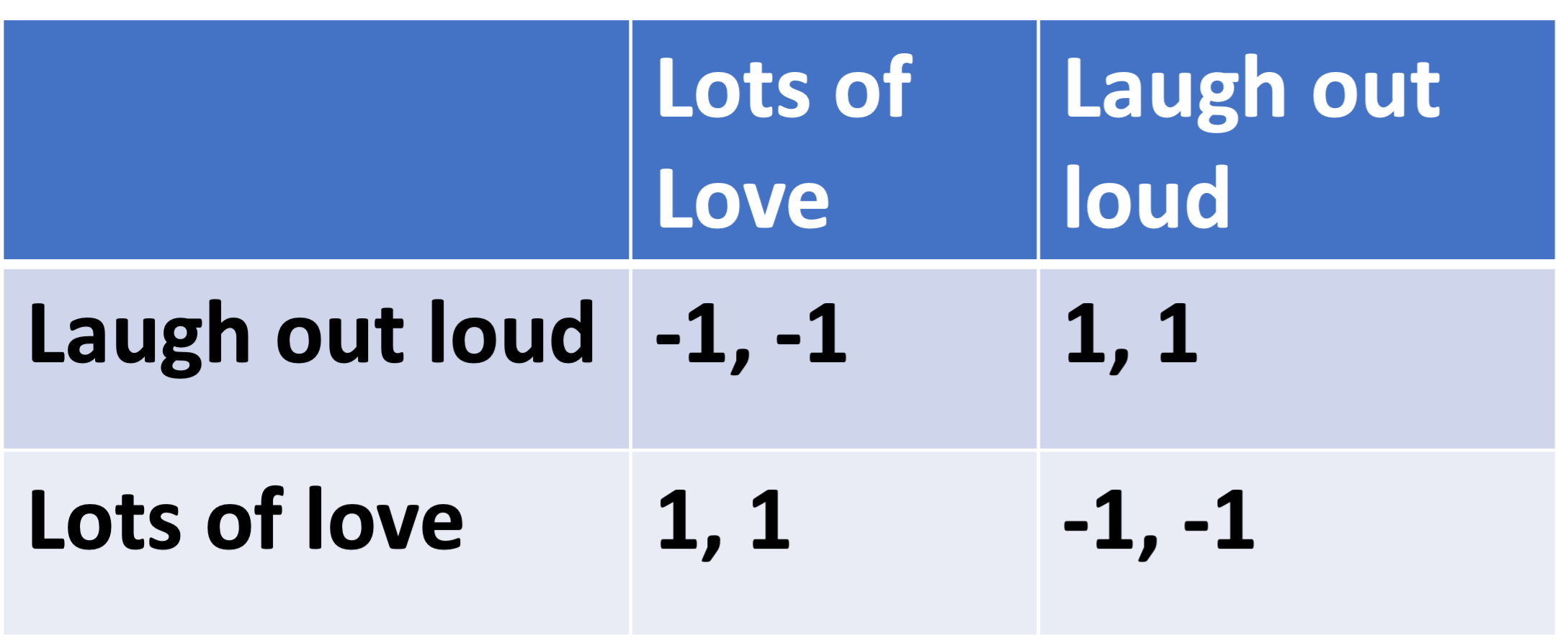
There are many other examples of this sort of thing, but the most famous one that comes to mind is from the Abbot and Costello routine Who’s on First? Abbot is using “who” to inquire about the identity of the person on first base, while Costello is using “Who” to refer to the name of the player on first base. Hilarity ensues.
What do we do when we become aware of such miscommunications? We laugh. The more fury and frustration is caused by the linguistic pratfall, the harder we laugh, as evidenced by the enduring hilarity of Who’s on First?
So the sense of humor is the sense of potential or actual coordination failures—a perceptual organ tuned to the norms, roles, signals, and conventions of the social and linguistic world, and how they might be flubbed, flouted, fumbled, bungled, or lost in translation. The costlier and more confusable the mix-up, the louder and longer we laugh to signal that we know (that the other person knows that we know) that it was erroneous, accidental, or… unserious.
Hmm… unserious. Now we’re getting somewhere. You see, laughter signals that we are not treating our failed communication as actual communication—that we are viewing the misalignment as a kind of “play” behavior of no real consequence. This allows us to smooth things over and keep the peace if you inadvertently say you “hooked up with” my mother. Laughter signals that we are not going to feel mad, scared, resentful, or guilty about the coordination failure. All of our potentially negative reactions are going to be turned off or erased from the public record.
As I put it in the paper:
Many animals have play signals that they use to differentiate play interactions from real interactions. Cetaceans use an open-mouth display (Maglieri et al., 2024), kea parrots use a warble (Schwing et al., 2017), canids use a bow (Bekoff, 1995), and rats use 50-kHz ultrasonic vocalizations (Kisko et al., 2015). More relevant to our purposes, chimpanzees use a panting sound, uncannily reminiscent of human laughter, during bouts of tickling, chasing, or rough-and-tumble play (Matsusaka, 2004). If we could translate this panting sound into words, it might be something like: “I understand that this is play aggression and not real aggression. I am not mad at you or afraid of you.”
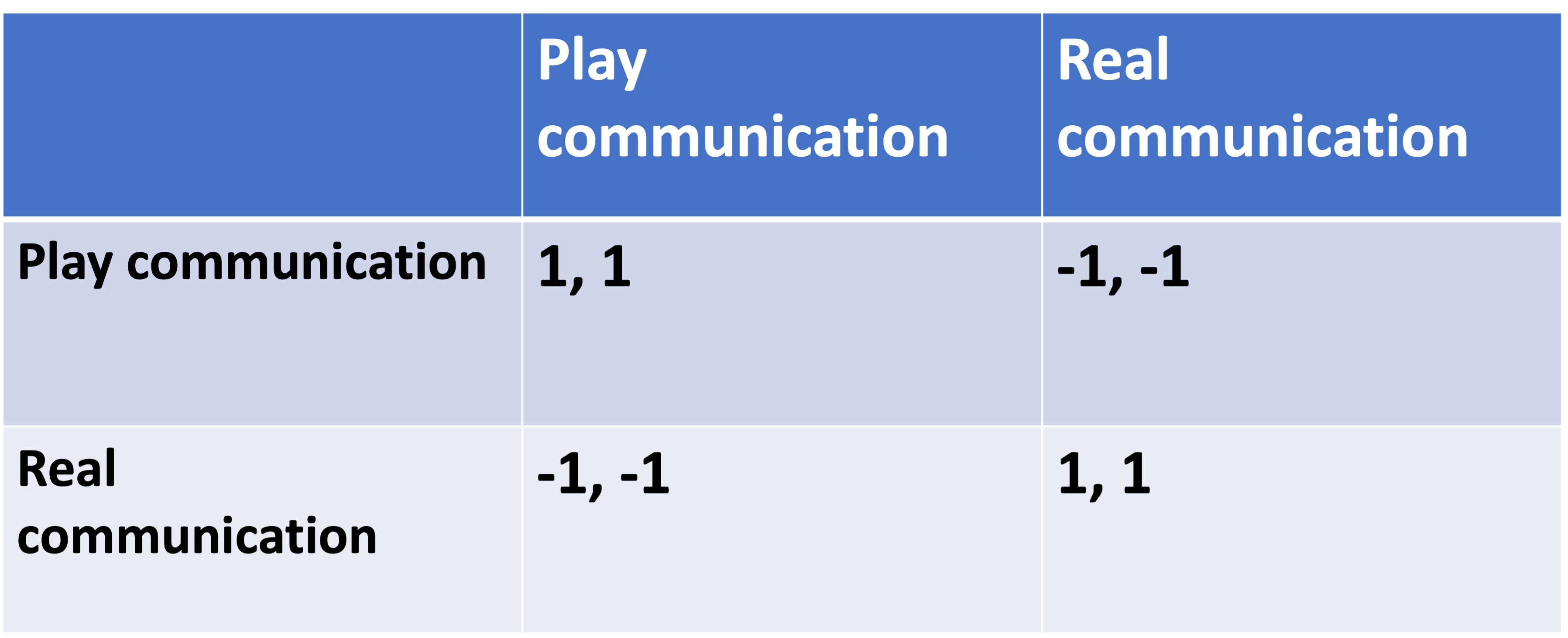
The panting sound is thus a kind of mix-up signal. It is designed to prevent or avoid mix-ups between play and non-play behavior. It is designed to keep play fights from descending into real fights, or play chases from descending into real chases. It is therefore an ideal message to send in the event of a faux pas, misunderstanding, miscommunication, or Freudian slip.
For example, if you have a favorite author, say Alexandre Dumas, and I accidentally refer to him as Alexandre “Dumbass,” we might laugh together to create common knowledge that “Dumbass” is not his name, that I mispronounced it by accident, that we both know this (and know that we both know this), that you’re not offended by the mispronunciation, and that I know (that you know that I know) that all is well in our relationship—no harm, no foul—and we can continue communicating about the French novelist as before.
To take another example, let’s say you accidentally say “LOL” in a funeral text thread, thinking it meant “lots of love.” Funny isn’t it? If we become aware of that semantic fumble, we could emit the primate panting sound and send the ideal message to each other: “We are treating this as play communication and not real communication. We are not taking it seriously. No damage has been done to our relationship.” The costlier the mix-up would have been if it went unnoticed, the more time we might spend reciprocating the play signal, and the more rewarding it should feel when we do that.
Here’s how I describe the mechanics of it:
We can think of the costliness, confusability, and mutual recognition of a mix-up as inputs into an emotional system: mirth or amusement—a system that likely overlaps with neural systems for play (Panksepp et al., 1984). The outputs of mirth might include: 1) an urge to laugh, 2) a heightened sensitivity to others’ laughter, 3) a motivation to reciprocate others’ laughter to the degree that it is sensed, matching the observed intensity, 4) feelings of reward in proportion to the magnitude of the costs defused by the reciprocally emerging laughter, as well as in proportion to the updated value of the coordination partnership, and 5) a deactivation of emotions that process costs, to ensure that the (potential) costs are not incurred or represented by either party, and that the process of common knowledge generation is not disrupted.
This last output is especially important, because we cannot successfully smooth things over if there is any observable fear, anger, or regret in either one of us. To display even a hint of these emotions—or to sense them in the other person—is to stoke doubts about whether you know that I know (that you know) that things have truly been smoothed over.
If mirth is well-designed, it should prevent illusory dangers from sending either party into a panic or meta-panic; it should prevent illusory transgressions (e.g., “hooking up with” my mother) from devolving into brawls; and it should prevent illusory insensitivities (e.g., “laughing out loud” at the death of a loved one) from destroying relationships. It should ensure that one does not regret a mistake that was never made or respond to a pat on the back with a roundhouse kick.
Unfortunately, pulling this off is a formidable cognitive challenge, a point I spell out in the paper:
Represented costs spread through the brain like wildfire (Sznycer & Lukaszewski, 2019; Sznycer, 2022), making their mutual defusal a difficult adaptive problem. It is often unclear what all the relevant costs to any mix-up might be (e.g., relational, reputational, physical, hygienic, economic), or all the relevant emotions the costs might feed into. A perceived insult could trigger anger, shame, guilt, sadness, regret, disgust, and fear in either the insulted party, the victim, or third parties, depending on the nature of the insult and its social context—and on what actions or events might be expected to follow from it. Insofar as mirth is well-designed, it might produce a general deactivation of emotions that process costs, in order to stop the wildfire of negative representations from spreading throughout the brain and disrupting the process of mutual cost defusal.
Another thing mirth should do is invert the cost of the mix-up insofar as it is being successfully defused or smoothed over. A larger fitness cost avoided is a larger fitness benefit gained. If the mix-up would have destroyed our relationship, then sensing it and smoothing it over would be analogous to the joy of reuniting with a loved one. It might also be rewarding for its information value: it might be an important mix-up to remember, laugh about with other people, and avoid in the future. “Good job for noticing this,” evolution might say.
The smoothing over should also be rewarding if it enhances, or honestly signals, our ability to coordinate with each other. If the mix-up would have gone unnoticed, or foolishly taken seriously, by less suitable partners, the smoothing over should make us realize how simpatico we are—or how good we are at coordinating with each other—adding additional positive vibes to the laughter. “This is an especially good social partner—keep hanging out with this one,” evolution might say.
Why mirth can be creepy
There are countless examples of laughter coming off as threatening or eerie. You see it in the cackling witch, the creepy doll, the scary clown, the Smile film series, the ‘muahaha’ of the supervillain, and the laughter that fills the halls of Arkham Asylum. But given that the function of mirth is to smooth things over in light of a mix-up, it is unclear why such a function would come off as creepy to other people. Wouldn’t it be comforting?
No, it wouldn’t. Since mirth deactivates emotions that process costs, to stop the “wildfire of negative representations” from spreading throughout the brain, it temporarily numbs us to the horrors of life. It desensitizes us to danger, threats, and angry outbursts. As I put it in the paper:
Mirth can transform a person into something rather frightening. It may deactivate their fear, making them impossible to threaten or deter. It may deactivate their empathy for others’ plights, transforming others’ suffering into a joke. Scowls of disapproval would be all but invisible. Threats of punishment and cries for help would fall on deaf ears. It is nearly impossible to get through to a mirthful individual or negotiate with them for better treatment. The only thing they can do is laugh in our faces.
This might explain why mirth can, if one is not sharing it, feel hostile, creepy, or even terrifying. The best example of the menacing nature of mirth comes from the character of the Joker in The Dark Knight, whose mirthful disposition conveys a sense of fearlessness and heartlessness: he cannot be bought, reasoned with, or negotiated with because he takes nothing seriously. He just wants to watch the world burn, unsaddened by—or perversely delighted by—the sight of a world in flames.
And now we have arrived at the payoff we were looking for: insight into the nature of seriousness.
What seriousness is
I can do no better than quote my paper again, so here it is, my serious theory of seriousness:
We can think of the phenomenology of seriousness as the opposite of mirthfulness—a state in which social or physical costs, either potential or actual, are being carefully attended to. If I’m angry with you, then you need to process the costs that I’m threatening to inflict on you (Sell et al., 2017). If something terrible has happened, we need to take that seriously and figure out what to do about it. To take something seriously is to devote non-mirthful attention to it—to be sensitive to its actual or potential costs.
But then what is a ‘serious person?’ It is a person who demands non-mirthful attention—a person who can inflict costs on others, either directly, through reputational or physical attacks, or indirectly, by withholding valuable knowledge or resources. A serious person is someone whose interests must be respected, whose threats must be heeded, whose absence is greatly felt. In the show Succession, Logan Roy tells his children they are not serious people. We can now see why his words cut so deep.
And we can also see why humor is so often political. To laugh at something is to not take it seriously—to turn off our fear in the face of a threat, our anger in the face of a provocation, or our empathy in the face of a suffering victim. Politics revolves around what we ought to take seriously as a society—what problems we must work together to solve—and mirth turns these problems into jokes. Authority is maintained by stern threats of punishment and disapproval, and mirth deflates it like a whoopie cushion. Politicians wield negative emotions as political weapons, and mirth leaves them weaponless. It is therefore unsurprising that people with stronger moral identities are less able to appreciate humor and generate jokes (Yam et al., 2019).
So we’ve arrived at our destination. We began with the greatest insult in the history of television, and now we have an explanation of its deeper meaning and even its evolutionary history. The nature of seriousness is just one of the many insights you can find in my paper, including explanations of absurdism, embarrassment, cringe, slapstick, comic timing, and why romance and comedy go together. I hope you take it seriously.
Another banger. I only skimmed the paper, but one thought I had was about irony (which I've been pondering for a long time without success).
Assume a three-player game with a speaker and two listeners: one naive, one savvy. The speaker wants to form a closer social bond with the savvy listener, who has a better sense of mirth, & exclude the naive listener. In the simplest case of verbal irony (sarcasm), they do something quite sophisticated & generally neglected by scholars of language: they send a signal that has two intended meanings, a literal one for the naive listener, an ironic one for the savvy listener. I think many forms of humour (including some of the absurd stuff you mention) are about forming an elite or high-status coalition, signalled by the use of irony (speech or other performance that is confusing or banal to a naif, funny or clever to the cognoscenti).
This can get more complicated & exclusive as more & more additional knowledge is required to "get" the ironic meanings. E.g. one needs knowledge of the conventions of some art form in order for their ironic subversion or absence to be understood, one needs insider political/cultural knowledge to get satire, etc. But ultimately it's about signalling & status. My own taste is towards hyper-ironic work that bends so far back on itself that it's not even about anything — the joke being the absurdity of all things. & even though I consume this privately it must on some level be about colluding with the author & feeling I'm savvy enough to be part of an elite.
In the Succession example, I’m not sure serious and mirthful could be plotted on an x,y diagram. Logan was always serious but was sometimes mirthful even when he didn’t intend it. The kids were never serious even when they intended it but were usually mirthful. Each variable needs to be considered from the perspective of the deliverer and the deliveree.