

Think of a sandwich.
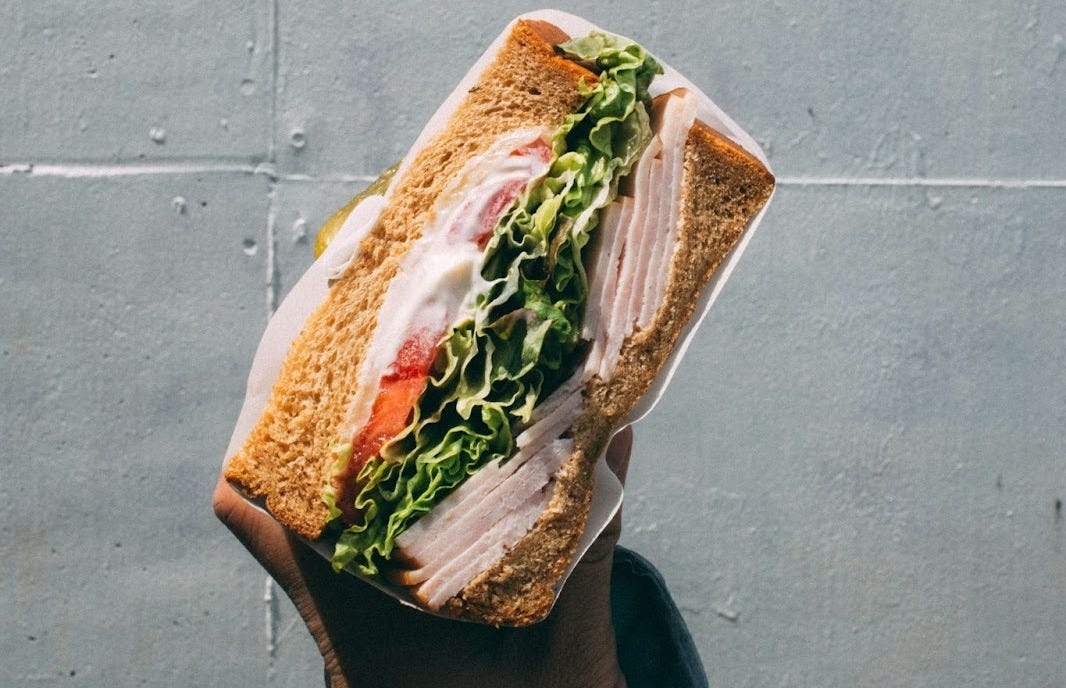
Yum. It’s got two slices of bread and some stuff in between. The price ranges from around $5 to $20. If you pay the price, you get the bread, the stuff in between, and the opportunity to insert it all into your face. Tastes, sounds, smells, and textures flood your awareness—a symphony of crunchies and creamies and chewies. If the sandwich is good, you can buy another one next week, or even later that day. If the sandwich is bad, you know what to do: don’t buy it again. Spit it out. Throw it away. Maybe ask for a refund or leave a negative Yelp review.
Okay, now think of a politician.

Uh oh. It’s got a tie and some hair and some stuff about supporting small businesses. The price is however long it takes to vote. If you pay the price, you get a .000001% chance of swaying the election in favor of the politician you voted for. Tastes, sounds, smells, and textures do not apply here. You’re not chewing or swallowing the near-zero effect of your vote on the country. If your vote was good, uh… good for you? If your vote was bad, well… so what? How do you know if your vote was good or bad? How could you know such a thing?
Given how weird and unimpactful a vote is, and how normal and impactful a sandwich is, it’s weird that anyone would vote when they could be eating a sandwich instead. And yet, millions of people vote, even when they’re kind of hungry. Even more puzzling, a sandwich goes into your mouth and makes you feel things, but a ballot goes into a dark box and makes you feel… well, what does it make you feel? I guess it makes you feel the warm glow of being a “good citizen?”
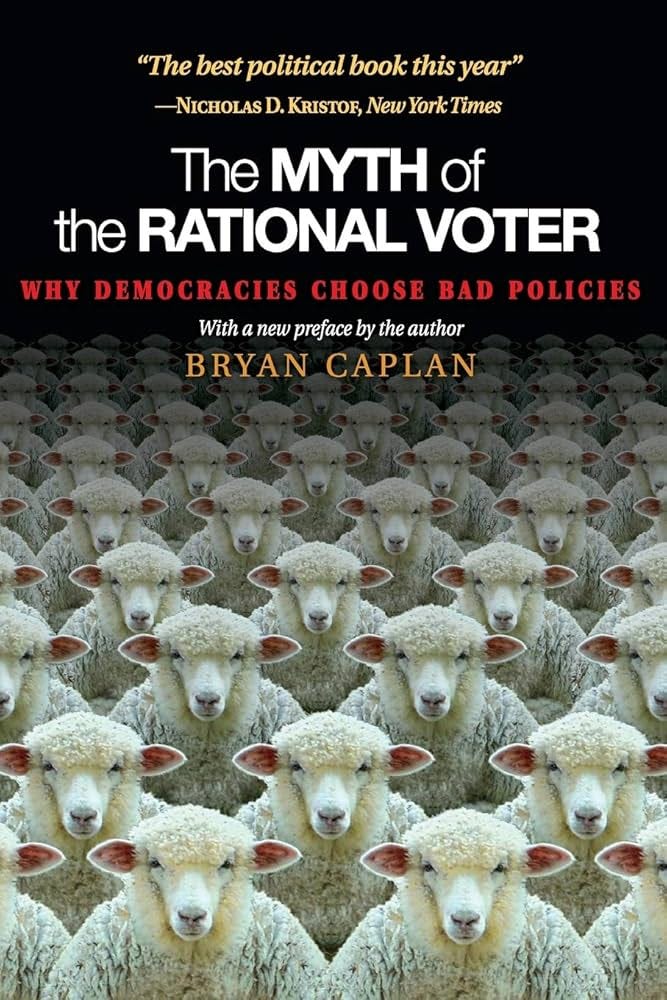
According to the economist Bryan Caplan, that warm glow is everything. It’s the engine of our whole dumb system. It’s what the voter is “buying” with their vote. They’re buying vibes. They’re buying the chance to feel noble and upstanding—to cosplay as Nelson Mandela or Greta Thunberg or something. A voter is like a toddler smashing buttons on an arcade game without putting in any quarters: they might be having fun, but they’re not having any influence.
And just as a toddler doesn’t think too hard about what buttons to smash on Tekken 5, a voter doesn’t think too hard about what policies to support in a democracy. Decades of research reveal jaw-dropping ignorance about what legislation has been enacted, who enacted it, what party controls Congress, who our elected representatives are, what the government even does, and how our political system works at its most basic level.
Besides, even if we focus on the narrow slice of citizens who know a bit of that stuff, they’ve got a different problem: tribalism. They can regurgitate political factoids when it helps them flatter their tribe or demonize their enemies. They’re well-informed about their country in the same way the apparatchiks at Pravda were well-informed about the Soviet Union. Voters tend to be ignorant, biased, or both.
Which shouldn’t surprise us. Voters are responding to their incentives. The odds of a single vote swaying an election are something like one in sixty million. Which means that my odds of shaping a political outcome are lower than my odds of getting struck by a meteorite. If it is crazy for me to worry about the impact of a meteorite on my body, then it is even crazier for me to worry about the impact of my vote on the country. If it is a waste of time for me to develop effective meteorite avoidance strategies, then it is an even bigger waste of time for me to develop unbiased political beliefs.1
Rationality is costly: it takes a tremendous amount of time and energy to vote wisely—to figure out the details of particular policies and what effects they might have on society. The problem is: voters have basically no incentive to pay those costs. If they can get all the good vibes and warm glows without doing any of the hard work of understanding reality, then that is exactly what they will do. Most voters will either ignore reality because they’re powerless to change it, or they will distort reality to flatter their tribe. Either way, reality slips through their fingers, and they have no reason to care.
The results are predictable: widespread voter irrationality, savvy politicians competing to manipulate irrational voters, and crappy policies enacted by bullshitting politicians elected by irrational voters.
Public choice meets evolutionary psychology
What I did just now—i.e., comparing the humble sandwich to the not-so-humble politician—was an example of public choice theory, the application of economic logic to political behavior. It didn’t need to be a sandwich and a politician. It could have been anything in the marketplace (cars, pornography, dental insurance), and anything in politics (logrolling, propaganda, filibusters). What matters is the underlying logic of costs and benefits.
It’s obvious what the costs of voting are—a bit of time and energy—but it’s not so obvious what the benefits are. What are voters getting in exchange for their vote? We already saw Bryan Caplan’s answer: they’re getting a “warm glow” or a good vibe. But in many ways, Caplan’s answer is unsatisfying. It raises a series of follow-up questions like:
Why does voting give people a warm glow?
Shouldn’t wasting our time at the ballot box make us feel bored or annoyed?
Why does the human brain, the product of millions of years of natural selection, find such a fruitless activity rewarding?
Caplan gives no answer to these questions. His theory is economically deep but psychologically shallow. Which leaves room for me, a psychologist, to add some depth. I will now try to tell you a plausible story about 1) why voting gives people a warm glow even though it’s a waste of time, and 2) why I felt a twinge of discomfort after writing the words “waste of time.”
The evolutionary psychology of democracy
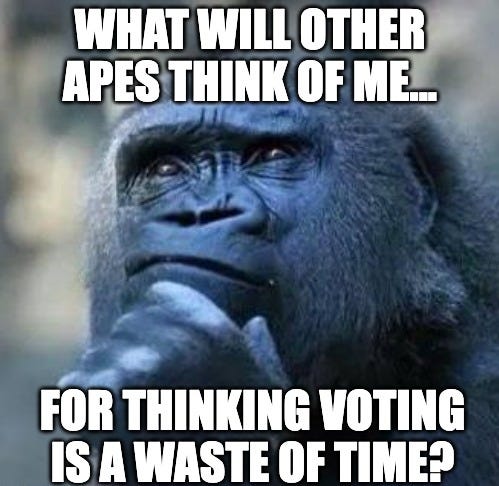
Throughout our evolutionary history, our ancestors faced a variety of threats to their survival and reproduction—feuds, raids, tyrants, power struggles—that no individual could overcome on their own. As a result, early humans evolved to do what the Autobots do in the Transformers movies. They evolved to click into a new shape, to transform from a set of isolated individuals into… a GROUP.
A group is a thing that binds itself together with orthodoxy and conformity. It’s a thing with rituals that demarcate insiders from outsiders. It’s a thing that manufactures narratives that justify sacrifices to insiders and hostility to outsiders. It punishes traitors, freeriders, dissidents, and other poisonous elements, while rewarding heroes, martyrs, and true believers. It produces feelings of meaning and inspiration in its members.
But then what causes us to click into the shape of a group? A context where we are weak as individuals but strong as a collective. Maybe it’s an unruly alpha male who’s dominating us. Maybe it’s a vengeful outgroup who’s plotting our demise. Maybe it’s an enormous beast that can only be felled by a torrent of arrows. It is this type of situation that, across evolutionary time, selected for all the cognitive machinery of tribalism. It is this type of situation, marked by the futility of individual toil and the power of collective synchrony, that activates something deep inside us: group mode.
So what is democracy? It is a key that perfectly fits the lock of group mode. It is a system that brandishes a fearsome weapon before our eyes—the coercive power of jails and cops and militaries—and tells us we cannot control it, and cannot defend ourselves from it, unless we band together into huge, lumbering groups. It is a system that pries power away from the hands of individuals and tosses it to mobs, cliques, unions, religions, interest groups, ethnic groups, and grotesque agglomerations of all the above called “political parties.” It is a system defined by the crushing hopelessness of individual toil and the awesome power of collective synchrony.
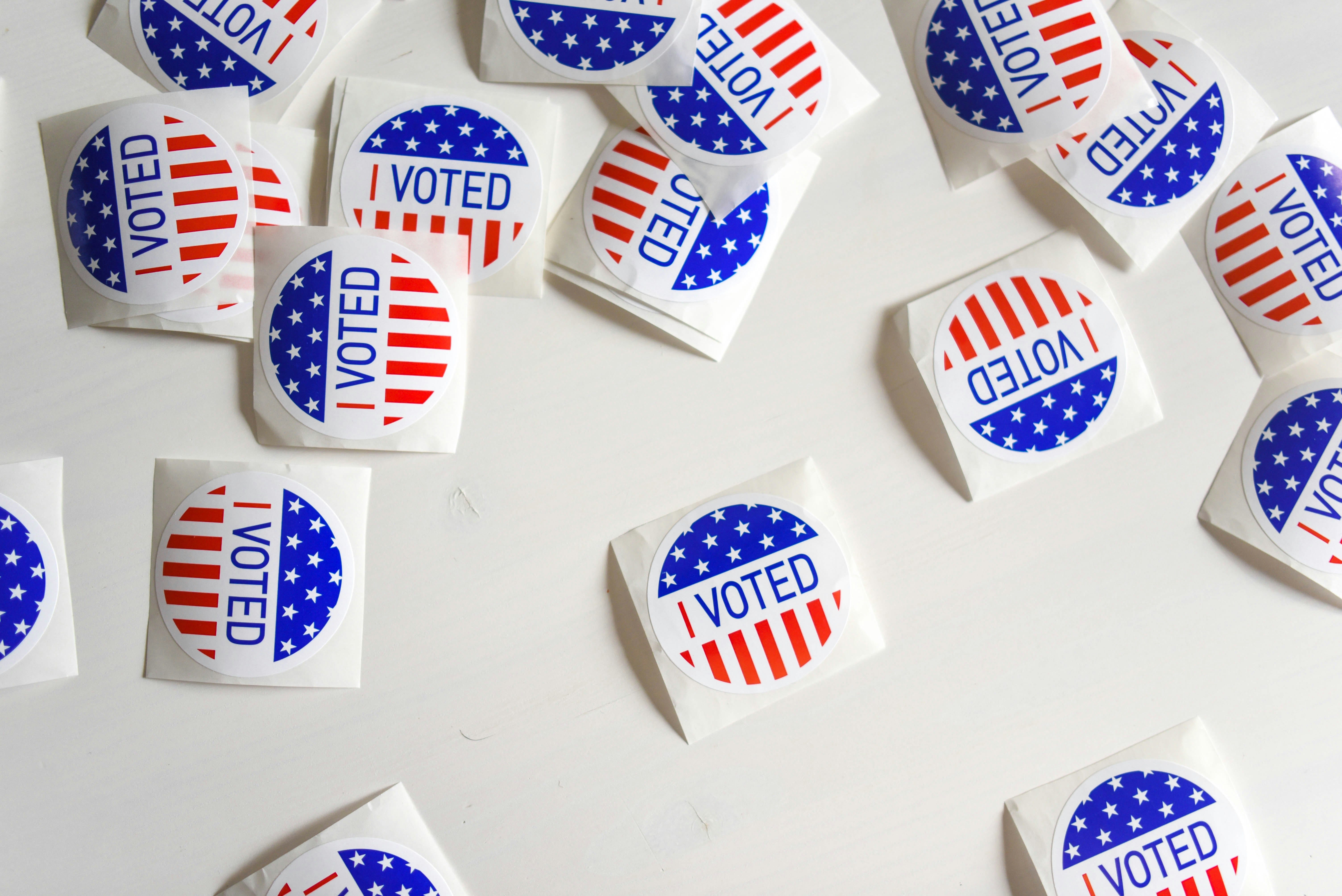
Once we recognize this, the political world comes into focus. We can see why dropping a ballot on top of millions gives our ape brains a rush of dopamine, and why we commemorate the ritual with a sticker that says “I voted” (instead of “I have accurate political beliefs”). Voting in unison is like chanting or dancing in unison: it sends a signal that we’re part of a unified force or hivemind—something larger than ourselves. We don’t vote to change the world: we vote to be part of a group.
Of course, not every member of the electorate is in group mode. Some citizens feel alienated by both parties and remain in individual mode. By and large, these are the people who don’t vote. They don’t feel any tribal allegiances—they don’t trust any politician—so they disengage from politics. In some ways, they see reality more clearly than the rest of us. The political scientist Diana Mutz has shown that the people who are best at “hearing the other side” and understanding opposing viewpoints are the least likely to vote and engage in politics.
So why is it taboo to utter the words: “Voting is a waste of time” (aside from the fact that they are vile, untrue words that I wholeheartedly repudiate)? Because we’re afraid of what those words can do to us. We’re afraid that they will jolt us out of group mode and into individual mode. People who don’t vote, or who tempt us into nonvoting with the sinful logic of probability theory, are freeriders and traitors—poisonous elements that threaten us from within. People who do vote (you know, for our guys) are heroes and true believers—defenders of the common good.
Individuals, on the other hand, don’t get it. “What’s so heroic about adding a grain of sand to the Sahara desert?” “Why should I bother learning about public policy when I have essentially no chance of influencing it?” These are the questions that flow through the mind of the individual when cogitating in individual mode. Groups have a hard time answering these questions, so they make them taboo.
If there’s a lesson here, it’s that democracy is not designed to empower the individual. It marginalizes and discourages the individual. Democracy is designed to empower groups. It is a government of groups, by groups, for groups.
And herein lies the problem: groups suck.
Why groups suck
“People are wonderful. I love individuals. I hate groups of people. I hate a group of people with a ‘common purpose’. ‘Cause pretty soon they have little hats. And armbands. And fight songs. And a list of people they’re going to visit at 3am.”
- George Carlin
1) Groups are dumb
It’s worth distinguishing between groups and crowds.
Groups are cohesive and stable. They act as a single unit. They meld their minds together, thinking and judging the same way. They synchronize their behaviors, which might include marching, chanting, or voting.
Crowds are diverse and dynamic. They act as many competing units. They contain a multitude of goals, beliefs, and experiences. Their members are unsynchronized and march to the beat of different drums.
Science, when it’s working well, is a crowd. It’s a motley crew of disagreeable weirdos who compete to be right about stuff. The referee of the competition is the cold, neutral arbiter of reality. Over time, the weirdos collect more and more data, winnow out the ideas that clash with it, and accumulate the ideas that make sense of it, until we get moon landings and lasers and atomic bombs.
Crowds are smarter than any individual because they aggregate the unique bits of knowledge scattered among their constituents. Groups are dumber than any individual because they stamp out those unique bits of knowledge and enforce conformity. If you remember one thing from this post, remember this:
Crowds are wise; groups are dumb.
A lot of people mistakenly think democracy is awesome because they confuse groups with crowds. They think everyone getting their voice heard is good for the nation because everyone has unique perspectives and interests.
But that is not how democracies work. Democracies do not combine the wisdom and experiences of every individual the way a crowd does. Not even close. Instead, what democracies do is obliterate those unique perspectives and force everyone to pick sides between two dumb groups. Or, in the case of non-U.S. democracies, several dumb groups.
Of course, the difference between a group and a crowd is continuous. On the extreme groupy end of the continuum you have cults, fanatics, and terrorists. On the extreme crowdy end of the continuum you have science, markets, and the common law. The problem with democracy is that it pushes us toward the groupy end and makes us dumber.
2) Groups see the world in black-and-white
Plants need sunlight. Fires need kindling. So what do groups need? Coordination. They need to coordinate on: 1) who they are (their identity), 2) what they’re doing (their agenda), 3) why it’s worth doing (their narrative), and 4) how they’re going to do it (their strategy).
If there are two conflicting answers to these questions, the group splits in two. Five answers? Five groups. After all, a group just is a collection of individuals with a shared identity, agenda, narrative, and strategy. What else would a group be?
So when a group fails to coordinate, it dies. When a group effectively coordinates, it lives. When a group coordinates more effectively than its rivals, it tends to outcompete its rivals for power, status, and resources. This kind of intergroup competition was probably a major selection pressure on Homo sapiens, giving rise to all our tribalism and groupthink. Over evolutionary time, coordinating with a large number of humans became very rewarding to us—a source of good vibes and warm glows.
The evolutionary game theorist Moshe Hoffman tried to mathematically model these kinds of coordination games and discovered an important insight: it is much easier for agents to coordinate on a categorical variable (i.e., black vs. white) than a continuous variable (i.e., many shades of grey). This explains why interracial conflict transformed the smooth continuum of human melanin levels into “black people” and “white people,” and why the genetics of family ancestry had to be reduced to a “one-drop rule” in the early-20th-century United States.
As another example, consider the variable: “tallness.” How tall counts as “tall?” Am I tall? Are you tall? Are we talking about tallness relative to members of our sex, or within our age bracket? If our goal is to form a group of tall people, questions like these will dissolve the group like acid. Uncertainty is the opposite of coordination—it is a kind of group poison—and if there is anything like an antidote to this poison, it is rituals.
Yes, rituals—inaugurations, blood oaths, catechisms, voting—stuff like that. An initiation rite collapses the smooth continuum of tribal loyalty into “one of us vs. not one of us.” A coming-of-age ceremony collapses the smooth continuum of human development into “child vs. adult.” A wedding collapses the smooth continuum of romantic entanglement into “married vs. unmarried.” A campaign rally reduces the unfathomable complexity of public policy into “good vs. evil.”
Think of a traffic light. If there was an undulating color gradient at every intersection, slowly morphing from seafoam to chartreuse to salmon to vermilion, that would be a disaster for traffic safety. The streets would be littered with car wrecks. There’s a reason why traffic lights have three easily differentiable colors: it helps the drivers coordinate.
The same logic applies to groups. If we want to form a group of tall people, we’ll need rituals. We’ll need to gather around a peerless leader who declares the sacred cutoff between tall and short—say, six feet and up—transforming the water of “height” into the wine of “ingroup vs. outgroup.” Then once we all agree on the cutoff (and agree that others agree), we’ll need hats and armbands and fight songs about how great it is to be six feet and up—and, perhaps, a list of short people to visit at 3am.
Groups are blind to shades of grey because they have to be. It is the only way they can survive as a group. If groups saw reality itself—the sprawling, chaotic, multidimensional continua of the universe—the social equivalent of “the streets” would be littered with the social equivalent of “car wrecks.”
So groups live in a cuboid world of jagged edges, sharp boundaries, and ritual demarcations. Black vs. white. Good vs. evil. Utopia vs. dystopia. Woke vs. antiwoke. Feminist vs. misogynist. Democracy vs. Hitler. Elites vs. ordinary people. Socialism vs. capitalism. Oppressors vs. oppressed. Left vs. right. Loving America vs. Hating America.
Which reminds me…
3) Groups suck at public policy
One of my favorite videos from The Onion was titled: “Everything You Need to Know about Charter Schools.” The video begins with a close-up on a man’s face, blank and expressionless. After a long, awkward silence, the man says: “Charter schools. You don’t like them.” And the video ends.
The video is funny because it’s true. Groups are too dumb to have nuanced opinions, so they divide public policy into buckets.
Bucket 1: We like this.
Bucket 2: We don’t like this.
My guess is that most Democrats know basically nothing about charter schools, aside from the fact that they’re supposed to not like them.
The same thing goes for any other policy issue like taxation or immigration or criminal justice. The mind-boggling complexity of these issues has to be crunched down into yaying vs. booing rich people, yaying vs. booing immigrants, or yaying vs. booing the police.
Which reminds me: groups are too dumb to engage in actual arguments. So any mild alternative to their position is dropped into a bucket called: “crazy.” Thinking a border wall is poorly conceived = supporting open borders. Doubting whether affirmative action is a wise policy = being a white supremacist. Pointing out Trump’s blindingly obvious ethical deficiencies = having Trump Derangement Syndrome. Thinking evolutionary psychology is a useful perspective = wanting to roll back women’s suffrage. Acknowledging the history of racial and gender oppression and wondering if we’re perpetuating it = the woke mind virus.
Now, if groups mainly see the world through the prism of black-and-white, categorical distinctions, then that is a big problem for electorates. Public policy is incredibly uncertain, multidimensional, and rife with trade-offs. The mind of a group is about as well-suited to public policy as the mind of a toddler is to quantum physics.
To give you a sense of how badly groups suck at solving social problems, here’s a list of solutions groups can’t figure out, because they’re too stupid:
Pigouvian taxes
About a hundred years ago, an economist named Arthur Pigou came up with a brilliant idea: tax goods and services in proportion to their negative externalities (or costs inflicted on third parties to the transaction), while subsidizing goods and services in proportion to their positive externalities. So instead of banning marijuana, for example, we’d tax it in proportion to its associated healthcare costs, allowing potheads to enjoy their weed while fairly compensating society for their unhealthy choice.
If governments were run by wise crowds, they’d have implemented evidence-based Pigouvian taxes and subsidies on every good and service a century ago, creating an economic utopia. Unfortunately, they’re run by dumb groups, so instead of Pigouvian taxes, we get a bunch of crude bans, including bans on marijuana, psychedelics, sex work, kidney selling (which is costing us thousands of lives per year), and most forms of labor migration (which is costing the world about half of global GDP). A ban is basically a 10,000% tax on the thing we’re banning. So instead of Pigou’s scalpel, we get a caveman’s club.
Making trade-offs
Security trades off against liberty. Liberty trades off against equality. Equality trades off against meritocracy. Meritocracy (which can lead to oligarchy) trades off against democracy. Democracy (with its committees and bureaucracies) trades off against swift, timely decision-making. Autocracy (or concentrated power in the hands of a strongman) trades off against equality, liberty, and human rights. So yes, life is hard, trade-offs are everywhere, and nearly every benefit comes with a cost.
Unfortunately, groups are too dumb to see this. Because if a politician acknowledges each side of a policy trade-off—the upside and the downside—he will be outcompeted by a silver-tongued bullshitter who sweeps the downside under the rug and shouts the upside from the mountaintops. “We can save the economy trillions of dollars and solve climate change!” Remember: politics is about groups coordinating on what to do, and if what the group should do isn’t blindingly obvious to everyone, the group dies. Uncertainty, trade-offs, and cost-benefit analyses are group poison.
Keyhole solutions
Bryan Caplan, in his book on the science and ethics of immigration, contrasts a gory amputation with a minimally invasive surgery. The latter is a “keyhole solution” to the patient’s problem with minimal collateral damage, whereas the former is a blood-spattered tragedy symbolizing American immigration policy. Groups can easily wield bonesaws like: “Mass deportations now” or “Let’s build a wall.” But they’re too dumb to perform endoscopic procedures like: “Let’s grant work visas to anyone who wants them while making full citizenship conditional on 18 years of gainful employment, a spotless criminal record, and a passing score on an English literacy exam.”
Counterintuitive solutions
You know what’s counterintuitive? The idea that raising the minimum wage might actually be bad for poor people by making it harder for them to get a job or afford things (1, 2, 3). Or the idea that preventing greedy corporations from charging us “too much” might actually be bad for everyone—a self-own that leads to disastrous shortages and disincentivizes production of the thing we need. Or the idea that most of our problems aren’t caused by left-wing or right-wing bogeymen but by overregulation of the housing market.
Because these ideas are counterintuitive and lack villains to boo, it’s hard for groups to coordinate on them. After all, if it’s counterintuitive to me, then it will be counterintuitive to you, which means I cannot count on you to rally behind it, and you cannot count on me to rally behind it. Like a new dating app, a counterintuitive political idea will struggle to get off the ground, because people will only get on board if they can be assured that others will get on board.
Icky-sounding solutions
Now what if the optimal policy sounds icky? What if it requires us to trade off the lives of the elderly against the wellbeing of the rest of society, do nothing in response to a terrorist attack, or let poor people sell their kidney? Well, then groups will struggle to coordinate on it. Because if it sounds icky to me, then it will probably sound icky to you. Which means I cannot count on you to rally behind it, and you cannot count on me to rally behind it.
Subtractive solutions
A lot of solutions to problems involve subtracting things—e.g., removing regulatory barriers to human challenge trials, shutting down counterproductive initiatives, balancing lopsided budgets, or simplifying our 10,000-page tomb of legal hieroglyphics so we don’t need a dedicated class of Egyptologists to decipher it. Unfortunately, there are five reasons why subtractive solutions are rarely found by democracies:
Subtractive solutions are counterintuitive which makes them group poison.
Subtractive solutions often sound icky to the groups being subtracted, or to their political allies, which makes them group poison.
Figuring out which Jenga blocks can be safely removed from the tower of legalistic minutiae is too difficult of a task for our dumb groups.
Some groups, like TurboTax, profit from the legalistic minutiae and lobby Congress to maintain it.
Individuals rarely notice (or know who to blame) when prices go up a little, taxes go up a little, or bureaucracies grow a little, but interest groups always notice—and get very pissed off—when they lose power.
4) Groups are incoherent
Let’s say you’re an individual who’s trying to gain power in a democracy. You look around for anyone who might be like you, with shared interests and common enemies, and you try to form a group with them. After spending a lot of time and energy, you pull it off! You formed a group.
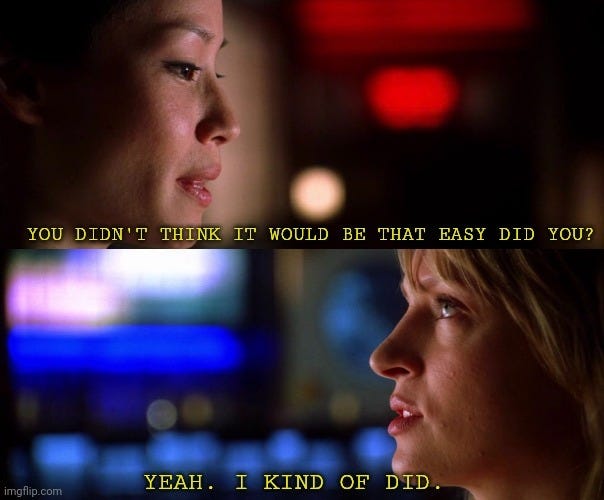
Unfortunately, you’re still powerless. Because to gain power in a democracy, it is not enough to form a group; you must somehow graft yourself onto a supergroup—a huge, hideous, multi-headed group of groups known as a “political party.” As they say, “politics makes strange bedfellows,” and there are no shortage of examples, from the bizarre alliance between Christian fundamentalists and libertarians to the cozy relationship between woke college students and Islamic theocrats. It would be hard to spin a coherent narrative that justifies these strange bedfellows, but that doesn’t stop us from hilariously trying.
Spinning propaganda for a multi-headed supergroup is hard, because what counts as good propaganda for one head will often be bad propaganda for a different head. To advance the interests of wealthy businesspeople, for example, I might rail against “big government” and talk about the virtues of free markets. But then to advance the interests of Christian fundamentalists, well… I’m going to look like a hypocrite, aren’t I? This sort of hypocrisy is all over the place in politics. Here are some examples of it on the political right:
The government should not interfere with our personal liberty to own a gun (but it should interfere with our personal liberty to consume pornography).
People should be allowed to express their political opinions freely in the workplace (but athletes should not be allowed to kneel during the national anthem).
People who are poor in America have no one to blame but themselves (unless they are working class white people, in which case they should blame immigration, international trade, and reverse discrimination).
We ought to be more suspicious of foreigners (but we should be more trusting of Vladimir Putin).
We must have more respect for “authority” figures (except climate scientists, the IRS, the EPA, the CDC, public universities, the national news media, and government regulators).
And here are some examples of it on the political left:
It is unfair for corporate CEOs to make millions of dollars a year (but it is fair for Hollywood movie stars to make millions of dollars a year).
We should not endorse negative stereotypes about a group of people based on their place of birth (but people from the south are racist).
A woman should have the right to do what she wants with her own body (unless she wants to sell her kidney, purchase private healthcare, or drink a large sugary soda).
We must stand in solidarity with labor unions (but not police unions).
We must show empathy and respect to all groups (unless they are uneducated, southern, working class, pro-life, devout Christians, businesspeople, white people, men, members of the military, or Republicans).
5) Groups are mean
The purpose of a group is to increase the power, status, and resources of the humans inside it relative to the humans outside it. How do we know this is true? Because over evolutionary time, the groups that reliably fulfilled this purpose became our ancestors.
This means our tribal psychology should possess a very important design feature. It should be very sensitive to the relative difference in payoffs between the ingroup and the outgroup—not the benefits to humanity as a whole.
This implies that political discourse will have a rather pungent, zero-sum flavor to it. It will revolve around issues where one group wins or another group loses. Politics as we know it will be defined by culture wars, class wars, regular wars, wars on Christmas, wars on women, wars on cops, wokism, anti-wokism, anti-anti-wokism, populism, nativism, anti-capitalism, Israel/Palestine, trans stuff, and the parties calling each other Hitler. (Pauses. Takes a look at political discourse.) Yep, this checks out.
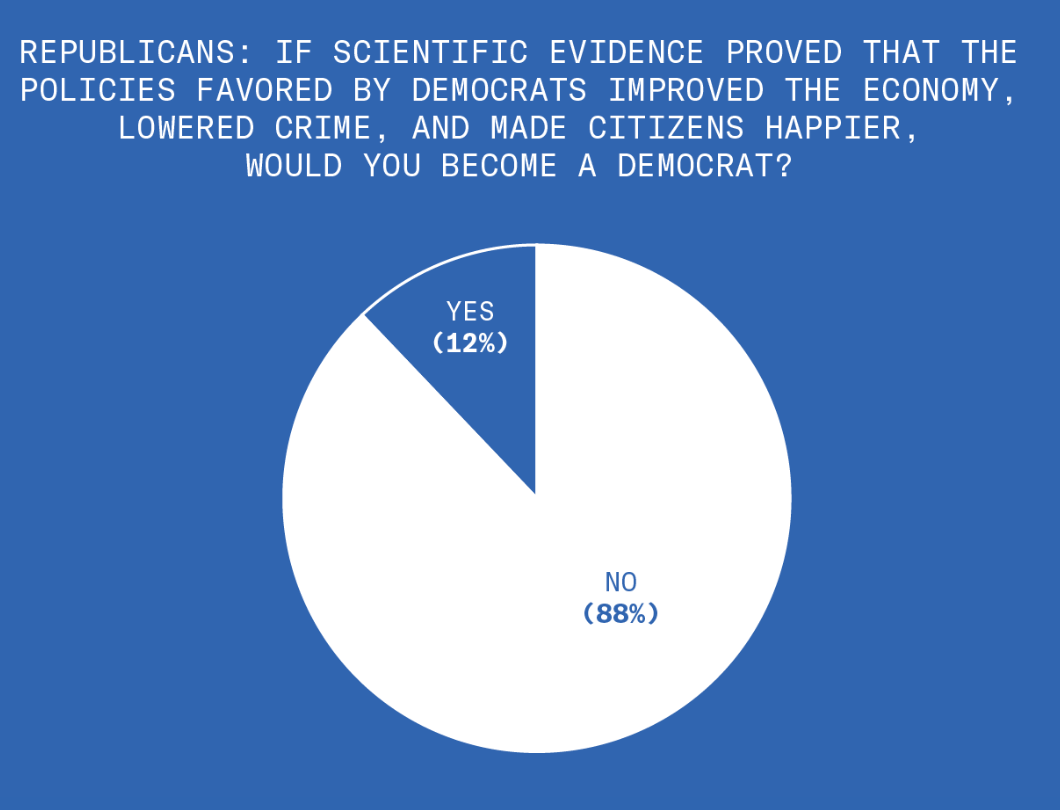
Of course, the most important winner or loser in politics is the party. We care deeply about our party winning, but not so much about the good of the nation or the planet. There’s a poll result I ran a while ago that makes the point rather starkly. I asked partisans whether they would switch parties if doing so would be better for the country.
And here are the results for Democrats:
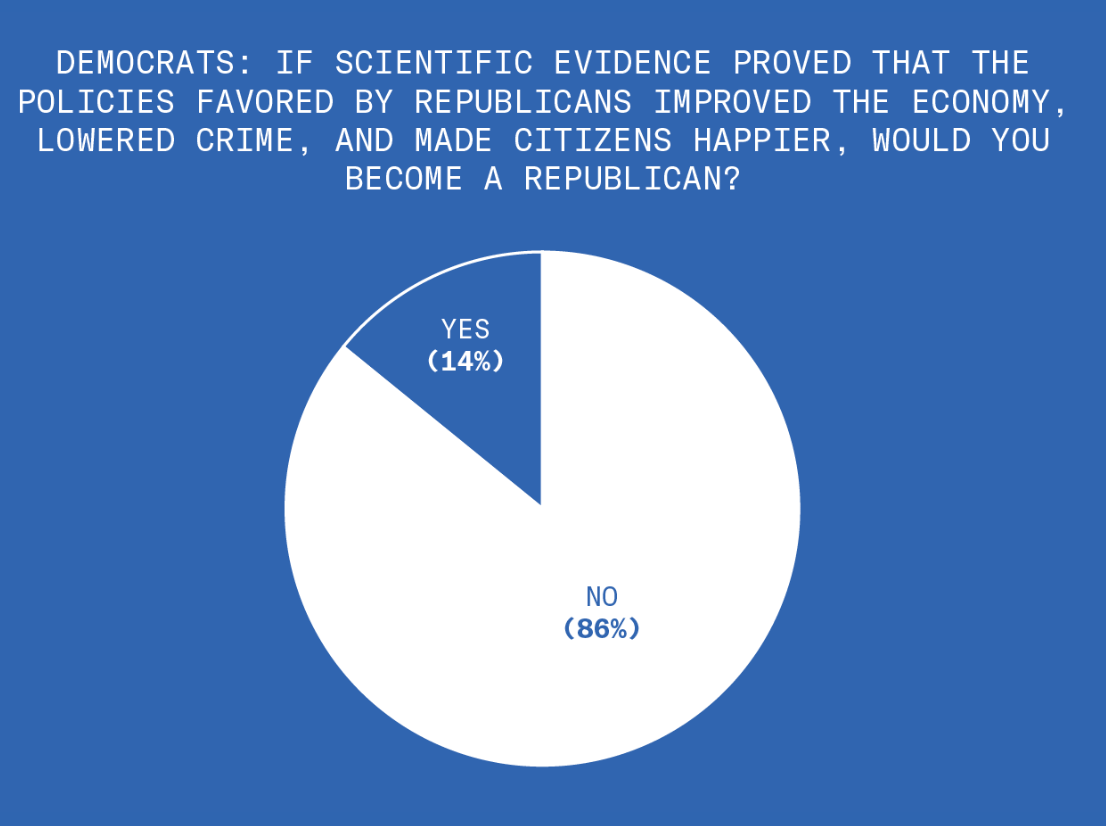
I’m just about the most cynical person in the world, and even I was surprised by these results. I was expecting lots of people to give a socially desirable response—to say they would switch parties for the good of the nation even if, deep down, they would never do such a thing. Once we account for social desirability bias, and remove the more disaffected people who are partisan in name only, the percentage of partisans who put party over country might be even higher.
6) Groups are sanctimonious
With all the bitter competition between groups, it is easy to lose sight of the fact that there is also a lot of competition within groups. And the main way human primates compete for status within a group is by virtue signaling—by advertising their devotion to the group’s sacred values.
Virtue signaling comes in a variety of flavors, but the important thing to remember is that it is not effective altruism. To do the most good, you want to minimize the costs you incur and maximize the benefits you provide—a kind of altruistic efficiency. But to signal virtue to your tribe, you want to do something closer to the opposite.
For example, if I walk five hundred miles, and then walk five hundred more, just to be the man who walks a thousand miles to fall down at your door, then I must really love you. I’m incurring a big cost (walking 1000 miles + falling over) to get a very small benefit (being at your door). The extreme cost/benefit ratio implies an extreme amount of devotion, which is what makes it such a great song lyric.
But suppose I live in the house next to you. If I walk five steps, and then walk five more, just to be the man who rings your doorbell, that doesn’t really signal much devotion to you. I might just be your annoying neighbor who wants to complain about your dog peeing on my lawn. But if I waited all day on your doorstep for you to come home, from morning to evening, calling you over and over and leaving hundreds of voicemails, then I must have really wanted to complain to you. What a psycho. Vary the cost/benefit ratio toward a big numerator and a small denominator, and you get a stronger signal that the person is a psycho who’s monomaniacally focused on the denominator. Most love songs are effectively signaling “I’m a psycho for you,” and a lot of political activism is effectively signaling “I’m a psycho for this cause.”
Which means that effective altruism and effective virtue signaling are, in some sense, opposites. The former is deliberately efficient; the latter is deliberately inefficient. The former is designed to help the beneficiary, the latter is designed to showcase the colorful plumage of the signaler, advertising how much of a psycho they are for social justice or unborn fetuses or whatever. The inefficiency—the wastefulness of the signal—is a feature, not a bug.
For example, if someone goes on a hunger strike, or immolates themselves in the town square, or reads the entirety of Capital in the 21st century, that really impresses us. “Whoa, look at how serious and political they are!” We’re not so interested in how much the self-immolation or the bloated book actually made the world better. That’s not the part we’re interested in. Besides, it’s too hard to figure that out anyways. We’re more interested in judging the person than we are in judging the consequences of their actions on the world.
So to impress our judgy peers, we submit to a gauntlet of trials and tribulations—ordeals of the mind, body, and spirit. We protest Israeli colonialism on a college campus by spraying graffiti on the gymnasium because that will surely make a difference in the Middle East. We show our devotion to the sacred environment by badgering our local grocery store into abandoning plastic bags and consequently increasing their carbon footprint. We post long, passionate political rants on the internet despite having a near-zero chance of convincing anyone who doesn’t already agree with us. And we take time out of our busy days to vote in national elections—“I VOTED” (look at me)—despite having a near-zero chance of affecting the outcome.
All of these “altruistic” acts reflect a very inefficient cost/benefit ratio: the benefits to recipients are tiny (or negative) compared to the costs. This suggests that the primary function of these and other “altruistic” acts is not to effectively help others, but to effectively signal our virtue.
So what happens when political groups care more about virtue signaling than actually helping people? Well, you get a lot of dumb, sanctimonious policies that don’t work and—all too often—make matters worse. Which reminds me…
7) Groups often make matters worse
There’s an important distinction we need to make. On the one hand, we have all the incoherent, sanctimonious things our supergroups want. On the other hand, we have all the things we, as wonderful individuals, want. People often confuse these two things, in the same way they confuse groups with crowds.
They shouldn’t. When groups compete with each other to control our cops and prisons, it results in a lot of bad outcomes that most individuals would not have preferred. For example:
Our supergroups might want to wage a “war on drugs” (rather than implement Pigouvian taxes that fund rehab centers), despite us as individuals not wanting the disastrous side effects like black markets, criminal underworlds, gang violence, mass incarceration, and abject cruelty to the worst-off people in society.
Our supergroups might want to regulate nuclear power to death, despite us as individuals not wanting to effectively ban one of the safest, cleanest, most reliable sources of energy available to us—and one of our best hopes of fighting climate change.
Our supergroups might want to impose price controls on greedy corporations to prevent them from charging us “too much,” despite us as individuals not wanting to experience the product shortages and perverse economic incentives that result from these dumb policies.
Our supergroups might want to regressively redistribute wealth from young people to old people, even though old people are about ten times wealthier than young people, and even though giving tax dollars to old people takes up nearly half of the federal budget, about three trillion dollars a year.
Our supergroups might want to make housing as scarce as possible (NIMBYism), despite us as individuals not wanting higher housing costs, longer commutes, declining fertility rates, rising pollution, rampant homelessness, a return of the landed gentry, and pretty much every bad thing you can think of.
Here’s how it works. People form groups to grab goodies from the government. If the group is a corporation, it gets subsidies and favorable regulations that enrich the corporation while harming its competitors. If the group is the “white working class,” it gets laws passed that prevent immigrants from cutting in on their ever-dwindling supply of low-skilled jobs. If the group is a bunch of farmers, it gets laws passed that give taxpayer money to farmers. If the group is an ethnic group, it gets laws passed that allow people to discriminate in favor of that ethnic group. If the group is a bunch of wealthy homeowners, it gets laws passed that prevent real estate developers from blocking their pretty views or changing the “character” of their neighborhoods. If the group is college-educated elites, it gets laws passed that regressively redistribute tax dollars to college-educated elites while creating perverse financial incentives for everyone else—you know, “student loan forgiveness.”
What happens when all these interest groups grab goodies from the government? Well, the interest groups benefit themselves enormously while harming everyone else imperceptibly—what economists call “concentrated benefits, dispersed costs.” Some of these concentrated benefits go to our political allies—the interest groups turduckened inside of our supergroups—which is why our supergroups love them. But we, as individuals, do not love them, because we don’t want to drown in the tsunami of dispersed costs.
Economists have a term for this kind of goodie grabbing—“rent-seeking”—because it is purely extractive and not productive. When rent-seeking proliferates in a society, it replaces productive activity, people get less interested in growing the pie than fighting over its slices, the pie shrinks, the fighting intensifies, and the society goes to shit.
This is not an accident. Rent-seeking is a predictable outcome of democracy’s incentive structure. If you give power to groups, they will use it to do what groups do—i.e., enrich, empower, protect, and privilege themselves at the expense of, or in disregard for, everyone else. And when groups compete with each other to do that, it’s easy to predict the results: intense intergroup competition over the coercive machinery of government, partisan gridlock, backdoor dealmaking (to overcome the gridlock), convoluted legislation, and the use of special interests as pawns in the political game. (Pauses. Takes a look at modern politics). Yep, this checks out.
Of groups, by groups, for groups
By now I hope you will agree that groups suck pretty hard.2 But in many ways, that’s beside the point, because not all groups are equally represented—or represented at all—in the political process.
First, many people can’t vote. Teenagers, felons, foreigners, and future generations cannot vote for less school, less jail, less ICE, or less deficit spending.
Second, about half of the eligible voters in the U.S. don’t vote. Probably because they’re still in individual mode and correctly think voting is a waste of time (sorry). So a majority of voters in the U.S. will not be a majority of the citizenry. It will be a minority of the citizenry.
Third, the minority of the citizenry that gets to enforce its will on the country with guns and prisons will only get to advance a small fraction of its interests. For example, both Republicans and Democrats contain a lot of ugly people, but we don’t have any anti-discrimination laws against ugly people. Why not? Because ugly people are hard to coordinate.
How ugly counts as “ugly?” Am I ugly? Are you ugly? Of course not—you’re beautiful and anyone who doesn’t see that is crazy. The problem is, people love to bullshit us with lines like this, even if we’re total uggos. So it’s really hard for someone to know if they’re hot or not, let alone how hot or not they are, let alone whether their level of not-hotness qualifies them to be a part of the “Ugly People Alliance (UPA),” let alone whether other people will agree that their level of not-hotness is… Look, coordination is hard, and if coordination is the only path to power in a democracy, then uggos are fucked.
The same is true of any other large, scattered, oblivious, heterogenous, unflattering, hard-to-categorize smattering of individuals. They’re not groups, and it’s hard for them to become groups. Dumb people, awkward people, lonely people—these poor souls will never make it through the thicket of group-poisoning questions on the path to power. They might as well be disenfranchised. And since coordination requires time, money, cultural influence, and social capital—the very things that disadvantaged individuals lack—the minority of people who dominate us with guns and prisons will tend to be a rather privileged bunch.
There’s tons of political science research showing that policies cater more to the preferences of elite, upper-class citizens—and small, wealthy interest groups—than to the preferences of everyone else. And it’s easy to see why: the well-to-do and well-connected are better able to mobilize, organize, hold fundraisers, disseminate propaganda, and lobby Congress. They’re better able to pump the lifeblood of time and money and status into their groups.
It gets worse. Since groups are mean and mainly care about zero-sum competition, the dominant political minority will often enact policies that hurt everyone, including itself. How? Well, groups will harm themselves whenever doing so enables them to harm their competitors even more. Partisanship is driven more by hatred of the enemy than love for one’s allies, so this kind of spitefulness is common in politics. It might even explain a lot of Trumpian populism. When society is ruled by mean, spiteful tribes, everyone—including the politically dominant minority—is made worse off.
Now reflect on the fact that our political parties burn tons of time and money competing with each other in a massive bonfire of outrage and meta-outrage, only to arrive at the same competitive advantage they started at. With every ad and counter-ad, protest and counter-protest, bullshit argument and counter-argument, the parties run as fast as they can to stay in the same place.
Imagine if we decided to channel all the time, money, and energy we currently spend on partisan warfare into learning science or enjoying nature or spending time with our families or engaging in effective altruism. The relative power of our political parties would stay the same, and the world would be a thousand times better. But of course, our supergroups cannot make this amazing deal, because they’re too dumb to understand it—and too mean to accept it.
The bitter truth
Monarchy is rule by monarchs. Oligarchy is rule by oligarchs. Democracy might seem like it’s rule by the “demos”—by the people—but it’s not. Or at least, not by individual people. Democracy is, instead, rule by tribes. Yes, it’s time to switch from “groups” to the more pejorative “tribes.” The most cohesive, well-organized, well-funded tribes, bound into supertribes called “parties,” are the ones who rule. It’s a tribeocracy. And given the well-documented ethical and intellectual downsides of tribalism, that is a very bad thing. It’s hard to think of a worse way to run a society than to systematically take power away from wonderful individuals and wise crowds so we can give it to mean, dumb, incoherent, sanctimonious tribes.
But there is a worse way to run a society, called autocracy, which leaves us with an important question: Why are democracies nicer places to live than autocracies? The main reason is that democracies are multitribal while autocracies are unitribal.
In a unitribal order, the ruling tribe can do whatever it wants, including killing or oppressing other tribes. In a multitribal order, attempts to kill or oppress other tribes will provoke a very loud “no thank you” from those tribes. Democratically enacted oppression tends to be self-eliminating, at least over the long-run, because it tends to mobilize the people being oppressed, transforming them into attractive voting blocs for politicians to recruit. Blatant, in-your-face oppression toward a sizable, easy-to-coordinate group of people is harder to pull off in a multitribal order than in a unitribal order.
Harder to pull off? Yes. Impossible to pull off? No. The nicest thing I can say about democracy is that it is pretty good at avoiding Hitler, except when it literally elects Hitler.
Another nice thing I can say about democracy is that it is better at holding politicians accountable than autocracy. If there’s one ruling tribe, complaining about it will get you executed or sent to the gulags. If there are many competing tribes, complaining about one of them will get you cancelled at worst. And since tribes subsist on common knowledge of their superior virtue, they will often expel the most flagrantly corrupt or incompetent leaders to save face. Though as we are seeing right now in America, that is far from a guarantee.
Another reason why democracies are nicer places to live than autocracies is that—with demographic shuffling, partisan gridlock, and ever-shifting alliance structures—no supertribe can stay in power long enough to do too much damage. The tribes evolve and realign, the politicians struggle to string together winning coalitions, and legislation devolves into a patchwork of unwieldy compromises and forgotten priorities—an arc that bends toward moral incoherence. Over time, the “concentrated benefits” get taken for granted, the “dispersed costs” pile up to the sky, and no one ever thinks to subtract anything. The final nice thing I’ll say about democracy is that it is more prone to slow decay than sudden collapse.
In conclusion, by integrating the collective wisdom of unique individuals—much like the scientific method, the marketplace, and the common law—democratic governance delivers precise, keyhole-fitting, cost-effective solutions to social and economic problems that can easily be undone or subtracted when mistakes are inevitably made. It works against our biases, enriches our understanding of reality, avoids the pitfalls of cronyism and rent-seeking and regulatory capture, gives every voter an invaluable one-in-sixty-million chance to shape the laws forced upon them by gun-wielding police officers, unites the great power of those police officers with great accountability, and gives us all powerful incentives to think carefully and rationally about the small number of problems that still remain in our society, which ought to fill us with hope for the future. We’ve done it, guys. We’ve discovered the ideal political system. How could we possibly do better than this?
Coda: how we can possibly do better than this
“David,” you say, “I get that you’re being sarcastic. But what’s the alternative? Is there an example of an incentive structure that doesn’t suck?”
Yes, there are many. I alluded to one of them just now: the old common law system that establishes legal precedents out of successful conflict resolutions, which survives to this day in the form of tort law or civil liability. I also mentioned a couple of others in the post, namely the scientific method and effective altruism (which, at its best, is just the scientific method applied to philanthropy). There’s also the marketplace, in which people compete to offer desirable goods and services at affordable prices. And then there are the incentives surrounding culture, norms, beliefs, and civil society. So if you’re looking for a takeaway from this post, it’s that we should give less power to democracy and give more power to these other things. As an individual, the takeaway might be: it’s okay to focus on these other things and ignore politics.
But maybe that’s too defeatist. In that case, you might be interested in how we can make democracy less stupid and bad. If you agree that mass elections are the problem—because they marginalize wonderful individuals while empowering dumb groups—then why not implement a form of democracy without elections? Why not pick some individuals at random from the population and appoint them as our legislators? Seriously. We can periodically call on people to do their legislative duty, have them vetted by rival advocates, present them with the case for and against a policy, and ask them to reach a consensus, much like the jurors we entrust with our lives. If trial-by-jury is good enough to sentence human beings to death, then why isn’t it good enough for public policy? This sort of thing is variously referred to as lottocracy, sortition, or citizens’ assemblies, and I think it’s a hugely underrated idea.
So here’s something to leave you with. Take power away from dumb groups. Give it to wonderful individuals. Better yet, wise crowds of them.
Yes, I’m aware of the effective altruist argument that voting matters because even a tiny probability of improving a massively important outcome can be worth it in the utilitarian calculus. There are three problems with this take:
It presupposes that utilitarianism is true—that the person casting their vote cares about, say, putting $1 in the pockets of 1,000,000 people as much as they care about putting $1,000,000 in their own pocket. I do not think this is a correct psychological description of voters, or of people in general. In fact, I don’t even think it’s a correct description of utilitarians.
It assumes that voters have 100% certainty about which candidate will be better for the world. But that’s the whole problem: it is extremely hard to have any kind of certainty about this, let alone 100% certainty. To acquire any degree of certainty about this would require massive amounts of research in pretty much every field of scholarly inquiry, as well as massive amounts of time figuring out how to overcome one’s political biases, which may not even be possible for apes like us. Also, there are lots of weird, hard-to-predict things to consider, like backlash to bad policies increasing support for good policies, or backlash to good policies increasing support for bad policies. The proper target of the utilitarian calculus is not voting conditional on 100% certainty about the effects; it is the time and effort needed to acquire even a modest degree of certainty about these effects.
The uncertainty of voting cuts both ways. A voter might be able to have a positive impact on the world if they have correct political beliefs. But they will also have a negative impact on the world if they have incorrect political beliefs. It’s plausible that the expected cost of being wrong cancels out (or at least reduces) the expected benefit of being right.
The point of this post is not that you shouldn’t vote. If you have accurate, unbiased political beliefs, then by all means, vote. The point is that most voters lack sufficient incentive to develop accurate, unbiased political beliefs.
For more on why voting is an unlikely candidate for effective altruism, see Brennan and Freiman’s (2022) paper in the Journal of Political Philosophy.
I’m talking about the incentive structure of democracy—not the character of unique individuals within it. To see what I mean, consider capitalism. It’s a system that incentivizes profit-maximizing behavior among firms. But there might be some really nice businesspeople who care about nobler things than profit and try to make the world a better place with their businesses. Maybe they’ll refuse to lay off an unproductive employee out of loyalty or compassion. Maybe they’ll take a pay cut to make their products more environmentally friendly. We can admit that these individuals exist under capitalism while also acknowledging that they are exceptions to the general rule of profit-maximizing behavior. If we want to understand the business world, we’ll have to abstract away from these nice individuals and focus on the bigger picture—the behaviors that are generally being incentivized by the system.
In the same way, democracy is a system that incentivizes tribalism, bullshit, and rent-seeking. Yes, there might be some really nice individuals who think wisely about public policy and devote themselves to the common good. Maybe they’ll develop accurate, nuanced political opinions despite lacking an incentive to do so. Maybe they’ll care deeply about overcoming their political biases or even switch parties for the good of the nation. We can admit that these nice individuals exist while also acknowledging that they are exceptions to the general rule of tribalism, bullshit, and rent-seeking. If we want to understand the political world, we’ll have to abstract away from these nice individuals and focus on the bigger picture—the behaviors that are generally being incentivized by the system.
So when I say “Democracy Is Bullshit,” I’m not saying: “Everyone who cares about politics is dumb and mean.” There are a lot of smart, nice people I read who care about politics and say insightful things about it. I’ve linked to many of them throughout this post. Instead, what I’m saying is: “Democracy is a bad incentive structure that generally produces bad results, albeit less bad than the results of autocracy.”
The notion of a Lottocracy is a SERIOUSLY underrated idea. There's no perfect system but we can do better than democracy.
When discussing a proposal to place all nuclear weapons in the hands of an international body, Thomas Schelling accused its proponents of wishing for "government without politics". Whether or not he was correct in that instance, it's a line that's stuck with me ever since I first read it and, well, it's a line I found myself thinking about quite a bit while reading this.
You cannot simply wish away humans' propensity to form groups. It's been a feature of virtually every political system humans have come up with, and probably every one we can come up with. I do think that lottocracy is an interesting idea that is worth trying in some capacity but, well, if you put 100 randomly-selected people in a room together, guess what, they will eventually sort themselves into groups.
Similarly, Pigouvian taxes are probably a genuinely good idea, you just have to sort out the tiny problem of how you're quantifying negative externalities. And it turns out that different people will think certain externalities should be weighted differently, whether due to simple differences of opinion, naked self interest, or something in between. And some of those people might group together to advocate for certain externalities being weighted more or less heavily and whoops, we're back in the messy realm of politics.
It doesn't help that you seem to conflate instances of genuinely irrational behaviour from groups (where most of the members of a group want one thing, but group dynamics push them to do another) with instances of groups simply accurately reflecting the views and interests of their members. i.e., there isn't some secret giant group of people who individually support nuclear power, but whom group dynamics push to oppose it instead; the groups that oppose nuclear power oppose it becauae most of their members oppose it, and they oppose it because they (mistakenly) believe it to be dangerous. If you randomly selected 100 people from the population, they wouldn't suddenly become more pro-nuclear.